

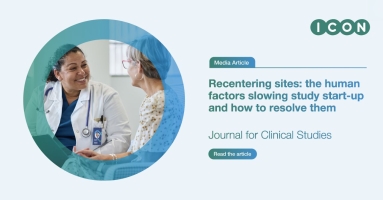

Participant-centric study design has advanced, but site-centric execution has not kept pace. In the Journal for Clinical Studies, Brian Mallon examines how unclear expectations, administrative burden and contract delays ...
ICON experts frequently author or contribute to industry trade press.
Filter media
Filter media articles by either clicking within the ‘Category’ drop-down list, or begin typing which will automatically match to the nearest available category. Note - not all categories will display results if selecting a particular year.
-

From biopsy bottlenecks to biomarker breakthroughs - how non-invasive tools are reshaping MASH trials
This article examines how non-invasive testing could transform the management of metabolic liver disease and help shape the future of MASH clinical development. It also outlines the rapidly evolving NIT landscape, emerging regulatory perspectives, and key opportunities to optimise MASH trial design and execution.
-

The CRA role’s co-evolution with clinical trial technology
As clinical trials become more complex, the role of the CRA is evolving from site monitor to strategic, digitally fluent partner, requiring expertise in hybrid oversight, risk-based monitoring, and multi-system data management.
-

Transforming central labs with automation and AI: setting new standards for modern trials
Demands on central laboratories are consistently increasing, heightening the challenge to deliver operational excellence and the highest standard of scientific integrity with both speed and agility. ICON Laboratories is transforming the way we leverage data and intelligent operational models to meet evolving trial needs.
-

Smarter strategies for systematic literature reviews
Conducting a high-quality, clinically relevant literature review can be challenging – it demands strategic thinking, methodological rigour and therapeutic expertise. ICON expert Rebecca Rozich explains why systematic literature reviews can be a powerful alternative to generating new data.
-

Promised land
As global pressures reshape the pharmaceutical and biotech landscape, sponsors are re-evaluating their outsourcing strategies. ICON’s recent survey of industry stakeholders highlights a clear trend toward fit-for-purpose solutions.
-

Collaborative R&D: Partnerships shaping the future of biopharma
Biotechs and pharma companies face rising costs of drug development, depleting R&D pipelines and diminishing returns on investment. By joining forces and exploring collaborative R&D partnerships it is possible to overcome these challenges. In addition to sharing risks, they share the potential rewards when their assets move further into clinical development or come to the market.
-

Mind the gap: The need for gender-specific outcome measurement
Women experience significantly more years of poor health than men due to delayed diagnoses and mischaracterized symptoms, despite living longer on average. This health disparity is rooted in systemic gaps in medical research and clinical trial design, particularly in how health outcomes are measured through Clinical Outcome Assessments (COAs).
-

The impact of drug pricing and reimbursement on the pharmaceutical industry
Drug pricing and reimbursement constraints are a major concern for the pharmaceutical industry. Companies must consider price and reimbursement across multiple countries, act early in the development cycle and ensure the evidence required to support their commercial strategy is built into their development plans.
-

Clinical strategies to optimize software as a medical device to treat mental health
Every clinical trial has challenges, but trials researching SaMD use to treat mental health disorders have unique ethical, regulatory and technical ones. In this Applied Clinical Trials article ICON’s Devin Ridgley and JoAnne Bronikowski explore the implications of a vulnerable patient population and new technology.
-

Partnering for success in early phase clinical development
Early-phase clinical trials serve as a pivotal step for biotech companies, laying the foundation for a drug candidate’s journey to market. However, these early stages present significant challenges—nearly half of all drugs entering clinical trials do not make it past phase 1. With the average phase 1 trial costing millions of dollars and consuming valuable time, biotechs have little room for error. This article discusses how partnering with a CRO can benefit a small biotech - helping to fill the gaps in knowledge, resources infrastructure.