

.jpg?w=340&itok=_weN-aN8 "IPT discussed in technical publications.")
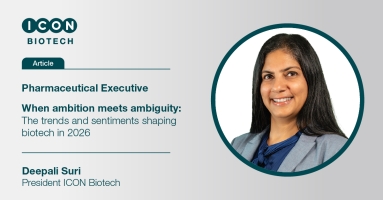

Deepali Suri, President of ICON Biotech, has been published in Pharmaceutical Executive. Her article draws on insights from 163 biotech leaders across North America, EMEA and APAC, supported by a supplementary survey o...
ICON experts frequently author or contribute to industry trade press.
Filter media
Filter media articles by either clicking within the ‘Category’ drop-down list, or begin typing which will automatically match to the nearest available category. Note - not all categories will display results if selecting a particular year.
-

Drug development practices to improve public health policy
In this article, Dr Andrew Garrett, Executive Vice President of Scientific Operations, explores the need for interdisciplinary collaboration between pharmaceutical and non-pharmaceutical researchers and public health centres to consider the overlap between NPIs and PIs and identify where standards can be improved and enforced.
-
Expert Q&A: The impact of the clinical trial liaison function
Expert Q&A: The impact of the clinical trial liaison function
The clinical trial liaison (CTL) function was first introduced in 2014 to help sponsors differentiate themselves from the competition by driving recruitment success in clinical trials.
FirstWord spoke with Elizabeth Pash, Senior Director of Global Site Engagement Operations at ICON, to find out exactly what this relatively new role involves, its value in developing and delivering optimal clinical trials and how it is set to evolve in future.
Summary points from the interview:
- In the competitive world of pharmaceutical research, sponsors can differentiate themselves by driving recruitment success in clinical trials.
- The CTL role was introduced in 2014 to bring doctorate-trained clinical research professionals into the clinical trial process to support site identification, activation and recruitment, ensuring optimal productivity of clinical trials.
- While CTLs and clinical research associates (CRAs) are both considered protocol experts and build relationships with sites, CTLs focus on the scientific aspects of a protocol rather than the eligibility criteria and schedule of assessments.
- At ICON, CTLs have contributed to a 20% boost in the targeted recruitment rate and helped approximately 70% of sites achieve their baseline recruitment goals. In the past five years, they have also helped sponsors bring nine new compounds to market and receive two new indication approvals for already-approved medications.
- As more clinical trials begin to incorporate more decentralised approaches, the need for roles like CTLs is set to steadily increase across the industry.
- Potential is increasing for CTLs to establish partnerships earlier with sponsors, supporting trial and protocol design, conducting targeted investigator interviews and applying the information in the early stages of clinical development.
[Subscription is required to view the entire interview]
-

Redefining CRO sourcing model terminology to optimise outsourcing strategies
Samir Shah, President, Strategic Solutions at ICON contributes to this Applied Clinical Trials article discussing the compelling need for new terminology for sourcing models in the CRO industry.
Reprinted with permission from Applied Clinical Trials. Applied Clinical Trials is a copyrighted publication of MultiMedia Healthcare, LLC. All rights reserved.
-

Supporting reimbursement decisions with data from external control arms
Data is at the heart of every decision made by CROs, and so can have significant legal and financial implications. In this article ICON experts weigh in on maximising the efficacy of data and ensuring the scientific rigour HTAs expect.
This article is taken from European Pharmaceutical Contractor, August 2022, pages 52-55. Samedan Ltd
-

Pharmacovigilance outsourcing: Ensuring a positive experience
Karen Johnstone and Sabine Richter discuss current outsourcing practices and tips for selecting a service provider to ensure a successful relationship.
-

Will big tech dominate healthcare in the years ahead?
Louisa Roberts, VP of Corporate Development and Partnerships, considers the benefits of partnerships with tech companies.
-

The ecosystem overtakes the producers in pharma and life sciences
This article discusses the substantial number of significant acquisitions and mergers in the pharma and life sciences industry, and features ICON’s $12bn acquisition of PRA Health Sciences back in February.
-

The central role of Interactive Response Technology in today's clinical trials
Michelle Lynskey, Global Head of Interactive Response Technology and Clinical Supplies Management, offers her insights on the role of IRT in clinical trials (pages 42-43).
-

How COVID-19 has changed pharmacovigilance
Dr Andrew Garrett contributes to this article in Pharmafocus: How COVID-19 has changed pharmacovigilance. The article explores how drug safety can be ensured while numerous vaccines and treatments come to market in record time to deal with COVID-19.
-
.jpg?w=545&itok=WjjDeARM "IPT discussed in technical publications.")
Data capture in a post-digital clinical trial landscape
A thought leadership article authored by Tom O’Leary on how collected data from digital health technologies, coupled with novel clinical trial models, have the ability to increase the value proposition of drugs and medical devices.
This article is taken from Innovations in Pharmaceutical Technology Autumn/Winter 2020, pages 38-40. © Samedan Ltd