

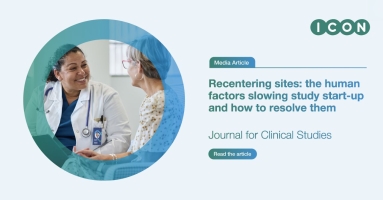

Participant-centric study design has advanced, but site-centric execution has not kept pace. In the Journal for Clinical Studies, Brian Mallon examines how unclear expectations, administrative burden and contract delays ...
ICON experts frequently author or contribute to industry trade press.
Filter media
Filter media articles by either clicking within the ‘Category’ drop-down list, or begin typing which will automatically match to the nearest available category. Note - not all categories will display results if selecting a particular year.
-

From biopsy bottlenecks to biomarker breakthroughs - how non-invasive tools are reshaping MASH trials
This article examines how non-invasive testing could transform the management of metabolic liver disease and help shape the future of MASH clinical development. It also outlines the rapidly evolving NIT landscape, emerging regulatory perspectives, and key opportunities to optimise MASH trial design and execution.
-

The next generation of pharmacological treatments for chronic disease
Despite their central role in glucose metabolism, native GLP-1 and GIP make poor therapies. Now, long-lasting, potent nutrient-stimulated hormone receptor agonists are prompting a shift to multi-indication metabolic therapies. Explore why.
-

Clinical trials - Keeping pace with shifting drug development paradigms for multi-indication therapies
In this article, learn how sponsors can drive multi-indication success through strategic trial design, early cross-functional planning, and evidence-driven development.
-

Unlocking the potential of GLP-1 based therapies with RWE
A recent ICON survey found fewer than 15% of sponsors use RWE to inform their multi-indication development strategy for obesity-related drugs. Learn best practices for leveraging RWE for GLP-1 based therapies in our article.
-

Cardiovascular outcomes trials revisited – methodological enhancements for greater clinical relevance.
ICON experts, Pierre Martineau and Adrienne Stoudenmire, share key considerations for successful CVOTs including study design, data strategy and technology in this new article.
-

Strategic Commercialisation of Multi-Indication Obesity Therapies: Balancing Early Access, Pricing, and Lifecycle Value
A 2025 survey of over 150 drug developers reveals that multi-indication development strategies have become central to the evolving cardiometabolic drug pipeline.
-

Survey of obesity developers suggests multi-indication approaches are vital but demanding
Following the rapid label expansion of drugs such as semaglutide and tirzepatide in recent years, drug developers have broadly adopted multi-indication strategies for obesity and related comorbidities. An ICON survey of 155 developers focused on these therapeutic areas reflects this growing trend.
-

Tackling the next frontier in metabolic trials: A Q&A with ICON experts
In this article, ICON experts explore strategies to help sponsors navigate the evolving obesity research landscape, highlighting the use of adaptive designs, master protocols, and other innovative approaches.
-

Obesity therapies and the multi-indication momentum: how industry is responding
The rise of GLP-1 agonist therapies has transformed obesity treatment, delivering unprecedented results and revealing their potential across a spectrum of interconnected conditions. New data reveals how the breakthrough has sparked a major shift toward multi-indication drug development.
-

ICON launches multi-indication trial design service for obesity drugs
Clinical trial designs for obesity treatments should accommodate candidate drugs that have the potential to treat multiple conditions, or developers risk missing opportunities, according to Irish CRO ICON.